HS Code Misdeclaration in Product Safety Controls in Türkiye: A Regulatory and Enforcement Perspective
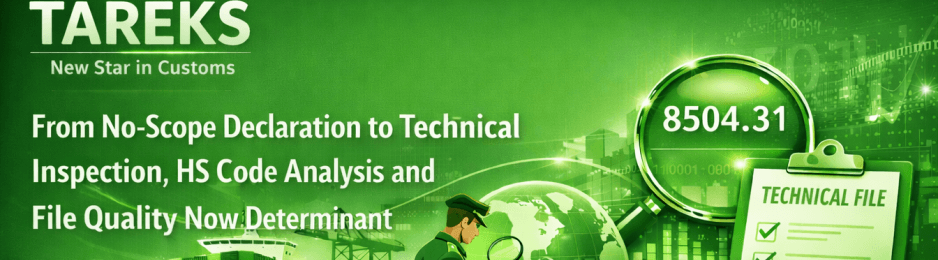
In the Turkish import regime, product safety controls are not structured as a separate compliance layer independent from customs declarations. On the contrary, the entire control architecture—particularly systems such as TAREKS and other conformity-based inspections—is directly triggered by the declared HS Code (GTIP). This structural linkage transforms HS classification into a regulatory decision rather than a purely technical exercise. As a result, any discrepancy between the declared classification and the actual nature of the goods has the potential to create significant legal exposure, especially where product safety controls are involved.
In practice, customs authorities do not evaluate HS Code discrepancies in isolation. Instead, they assess whether the incorrect classification has led to the circumvention of mandatory controls such as conformity assessments, CE marking obligations, or ministry-specific product safety inspections. Where such a link is established, the issue is elevated from a classification error to a compliance violation with direct administrative consequences. This approach is clearly reflected in administrative practice and further clarified through General Circular No. 2016/9, which standardizes the application of Article 235 of the Turkish Customs Law in cases involving misdeclaration of regulatory status.
From an operational standpoint, the most critical risk arises in scenarios where goods that are in fact subject to product safety controls are declared under an HS Code that falls outside the relevant control lists. This situation is frequently encountered in product groups subject to TAREKS, where the classification determines whether a shipment is routed to inspection, document control, or direct clearance. When a product that should have undergone a safety control is instead declared as non-controlled, customs authorities interpret this not merely as an incorrect tariff position but as a misrepresentation of the regulatory framework applicable to the goods.
The legal consequences of such a situation are governed by Article 235/1(c) of the Turkish Customs Law, which introduces a particularly strict penalty regime. Where goods are declared as if they are not subject to permits, licenses, or conformity requirements, while in reality they are, the legislation foresees not only the collection of any applicable duties but also the imposition of an administrative fine amounting to twice the customs value of the goods. In more severe cases, particularly where compliance cannot be retroactively ensured, the goods may be subject to seizure and liquidation. The significance of this provision lies in its deterrent nature; it is designed not simply to correct errors but to penalize the avoidance of regulatory oversight.
The administrative interpretation provided under General Circular No. 2016/9 further deepens this framework by clarifying how such cases should be handled depending on the timing of detection. When a discrepancy is identified during the customs clearance process, the administration adopts a relatively procedural approach by directing the importer to the relevant authority and granting a defined period to complete the required product safety controls. This mechanism allows for corrective compliance, provided that the importer is able to obtain the necessary approvals within the prescribed timeframe. However, this flexibility is strictly conditional and does not extend to all cases.
A fundamentally different enforcement approach applies when the discrepancy is identified after the release of the goods, typically through post-clearance audits or subsequent controls. In such cases, the customs administration initiates a process whereby the competent authority is requested to evaluate the compliance status of the goods within a defined period, generally three months, extendable up to six months. If the authority confirms non-compliance or fails to provide a response within the allocated timeframe, the law operates automatically, and the penalties under Article 235 are imposed. This structure demonstrates that the risk associated with HS Code misdeclaration is not confined to the border but extends well into the post-importation phase. A more detailed perspective on how such post-clearance situations escalate into finalized liabilities can be found in Missing an Electronic Customs Notification in Türkiye: When the Debt Becomes Final and What Can Still Be Done .
The most critical and high-risk scenarios, however, arise where the administration identifies elements of misrepresentation. This includes situations where conformity documents are declared as if they exist when they do not, where technical documentation is incomplete or misleading, or where the product description has been intentionally simplified to avoid triggering product safety controls. Under the framework clarified by General Circular No. 2016/9, such cases eliminate the possibility of corrective action. The administration proceeds directly with the imposition of penalties, without granting additional time for compliance, reflecting a strict and zero-tolerance enforcement stance.
From a professional customs advisory perspective, the key takeaway is that the Turkish system integrates classification and product safety compliance into a single control logic. This integration requires companies to approach HS Code determination not as an isolated technical classification exercise, but as part of a broader regulatory assessment process. In practical terms, this means that classification decisions must be supported by technical documentation, conformity analysis, and a clear understanding of the applicable control regimes before the goods are shipped. Companies facing enforcement outcomes or administrative penalties should also consider structured response strategies as outlined in Customs Settlement, Objection and Litigation Processes in Türkiye .
For foreign exporters and importers, this creates a need for a more structured compliance strategy. Product characteristics, technical specifications, and intended use must be carefully analyzed in advance, and the resulting classification must be tested against all relevant product safety regulations. In addition, documentation consistency across commercial invoices, technical files, and customs declarations becomes critical, as discrepancies between these elements are often the starting point of enforcement actions.
In conclusion, HS Code misdeclaration in the context of product safety controls represents one of the most significant compliance risks in Turkish import operations. The regulatory framework, reinforced by Article 235 and clarified through General Circular No. 2016/9, establishes a strict and highly enforceable penalty regime designed to prevent the circumvention of product safety controls. Companies that fail to align classification with regulatory obligations face not only financial penalties but also operational disruptions and long-term audit exposure. In this environment, proactive compliance—integrating classification accuracy with product safety analysis—is not merely a best practice, but a fundamental requirement for sustainable trade operations in Türkiye.
Other posts by this author